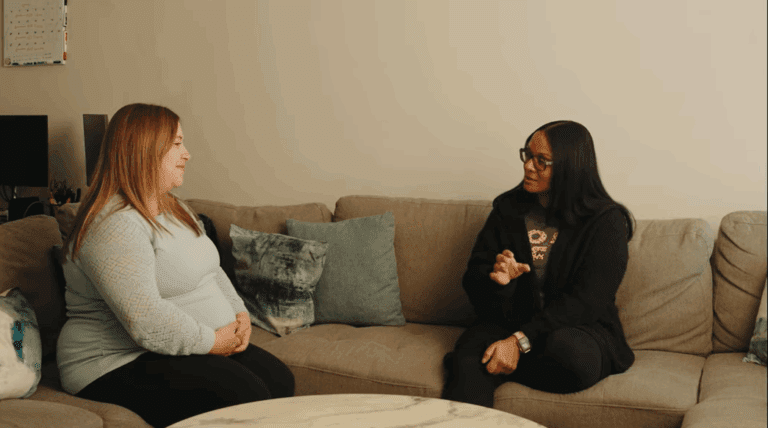
There is a kind of strength that doesn’t make headlines. It lives in alarm clocks set for 5 a.m., in the impossible math of rent versus childcare versus groceries, in the extraordinary lengths a mother will go to keep her children housed, fed, and safe.
At Charlotte Family Housing (CFH), 96% of families we support are single-mother-led. That number is not a coincidence. It is the predictable output of a system that was never designed to support them.
The Data is Stacked Against Her
Women are 35% more likely to live in poverty than men, and single mothers represent the most economically vulnerable household type in the United States.¹ Women make up more than 80% of single-parent households nationally and serve as nearly all primary caregivers for children. Women of color — and Black single mothers in particular — face the steepest barriers, shaped by compounding forces: wage disparities, generational wealth gaps, and the long shadow of discriminatory housing policy.²
The wage gap is not an abstraction. It shows up every month, in the gap between what a job pays and what rent costs. In Charlotte, a single mother working a minimum-wage job would need to work between 80 and 139 hours per week just to afford a modest two-bedroom rental.³ That’s not a personal budgeting problem, it’s a systems problem.
Add in the cost of childcare — typically $1,200 to $1,600 per month for a single child — many mothers face an impossible calculus: pay rent, or pay for the childcare that allows her to work and pay rent. This is the kind of circular trap that no amount of individual discipline or resourcefulness can fully escape.⁴
The structural forces are well-documented. Occupational segregation keeps women concentrated in lower-wage industries. Childcare deserts make reliable work nearly impossible to sustain. Limited family leave policies force mothers to choose between newborns and paychecks. Eviction policies have historically fallen harder on women.⁵ And domestic violence — often invisible in public data — is one of the leading causes of homelessness for mothers and children.⁶
Beneath these structural pressures are generational ones. Unpaid caregiving has always fallen disproportionately on women. Student debt loads are heavier for women. And for families of color, historic housing discrimination — redlining, loan denials, access barriers — created wealth gaps that still shape who can access stable housing today.⁷
These pressures multiply. A Black single mother navigating the rental market while managing childcare, working multiple part-time jobs because no single employer will offer flexible hours, and carrying the full mental and emotional weight of running a household is experiencing an intersection of several structural barriers all at once.
The Emotional Toll It Takes
There is a concept researchers call “the mental load” — the invisible labor of keeping a household running. The appointments, the permission slips, the tracking of what food is in the refrigerator, the crisis management, the planning for every contingency. For a single mother with no partner, no family safety net, and no financial margin, this load can crush her.⁸
A day-in-the-life perspective reveals something that data may miss: what it takes to hold a family together is not just income. It’s time, logistics, energy, and an almost impossible ability to absorb shocks — job loss, a sick child, a car breakdown — without the buffer most two-income households take for granted.
How CFH’s Model Centers Women
Charlotte Family Housing’s approach to ending family homelessness moves through three pillars: House. Empower. Equip.
Stable housing is not just a physical outcome for children — it is a developmental one. Research on Adverse Childhood Experiences (ACEs) consistently shows that instability in early life has lasting effects on health, cognition, and economic trajectory.⁹ Stability is an intervention in itself.
Empowerment-focused trauma-informed care recognizes that many of the mothers entering CFH’s programs have survived domestic violence, eviction, chronic instability, and loss. Healing is not separate from economic mobility. A woman who is still in survival mode cannot fully engage with job training, financial planning, or housing applications.
The equipping tools CFH offers — financial literacy, career development, life skills — are impactful because they meet women where the system has failed them. These are tools that the economic mainstream never designed with a working mother’s schedule, caregiving responsibilities, or lived experience in mind.
Women Supporting Women
There is something particular about women in corporate and professional settings gathering around this issue. Many are mothers themselves. Most have experienced, at some level, the weight of balancing professional expectations with caregiving responsibilities. They know — even if their circumstances are different — what it means to feel stretched thin.
The mothers CFH serves are doing all of that without safety nets, without generational wealth, without support networks, and without margin. When women with resources and platforms stand alongside women without them, something real can change.
Closing: Mighty Like a Mother
The mothers in CFH’s program are navigating a system that was not built for them, managing complexity that would overwhelm most people, and doing it with a level of love and determination that is remarkable.
When we say “mighty like a mother,” we mean it without irony or sentiment. We mean that there is a specific, extraordinary kind of strength at work here — and it deserves to be met with the full weight of what a community can offer.
Footnotes
¹ U.S. Census Bureau, Current Population Survey, Annual Social and Economic Supplement. Women’s poverty rate relative to men’s; single-mother household poverty statistics.
² National Women’s Law Center, Poverty Among Women and Families (annual); Institute for Women’s Policy Research, wage gap data by race and gender.
³ National Low Income Housing Coalition, Out of Reach report, Charlotte, NC data (pages 8–90.
⁴ Child Care Aware of America, The US and the High Price of Child Care, annual report. Childcare cost estimates for one child in the Charlotte metro area.
⁵ Matthew Desmond, Evicted: Poverty and Profit in the American City (Crown, 2016); research on gendered patterns of eviction.
⁶ National Alliance to End Homelessness, Domestic Violence and Homelessness fact sheet; National Network to End Domestic Violence annual reports.
⁷ Richard Rothstein, The Color of Law: A Forgotten History of How Our Government Segregated America (Liveright, 2017).
⁸ Allison Daminger, “The Cognitive Dimension of Household Labor,” American Sociological Review 84, no. 4 (2019): 609–633.
⁹ Centers for Disease Control and Prevention, Adverse Childhood Experiences (ACEs) research; Vincent Felitti et al., “Relationship of Childhood Abuse and Household Dysfunction to Many of the Leading Causes of Death in Adults,” American Journal of Preventive Medicine 14, no. 4 (1998).